


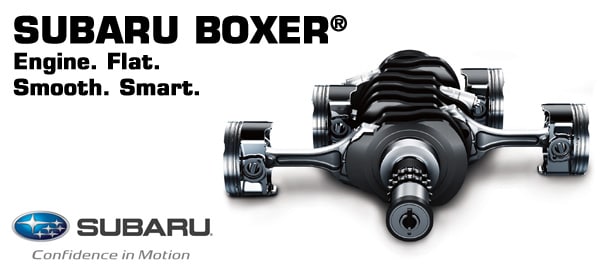
There are plenty of things that set Subaru apart from other car manufacturers. Environmental responsibility is one, and quality vehicles is another. It’s not uncommon to spot a Subaru from the 80s or 90s still running strong. In fact, 96% of Subarus built in the last 12 years are still on the road today. Longevity is key for Subaru and one of the reasons Subaru vehicles run as long as they do is the Boxer engine.
The jab is one of the most important punches in a boxer's arsenal. The quick in-line forward and back motion is effective in and efficient. The reason you don't see a good boxer throwing haymakers for 12 rounds is because it's not an efficient use of energy. Jabs have an optimal power for energy ratio. Subaru’s Boxer engine mimics the efficient jab movements of a boxer, and with its opposing cylinder layout there is a counter punch for every punch.
Subaru's Boxer engine uses a unique horizontal design that generates less vibration which increases the durability of the engine itself. Horizontally opposed pistons are incorporated in both the 4 cylinder and 6 cylinder Boxer engines. The movement from the opposing pistons cancel out each others vibrations. This makes the engine run more smoothly and increases its lifespan. Unlike the Subaru Boxer engine, V-shape engines don’t naturally reduce vibrations. Many V-type engines will use balance shafts to cancel vibrations, but this adds mass which reduces efficiency.
Another thing that makes Subaru's engine so great is the low profile. Since the pistons are laid out horizontally, the entire engine can be flatter than an in-line or a v-type engine. In addition to being low profile, the Subaru Boxer engine is very nearly perfectly symmetrical. This provides a smooth and even ride with a low center of gravity.
Subaru's Boxer engine is designed perfectly for longevity and durability. That’s why you see so many old Subarus on the road today!
Categories:
Social